EPFO Alert for new rule of 2025 :-
According to the news agency PTI, on Tuesday, June 24, 2025, Union Labour and Employment Minister Mansukh Mandaviya announced that the Employees Provident Fund Organization (EPFO) had increased the auto claim settlement level of provident funds (PF) in order to facilitate quicker fund access.

The agency report said that the EPFO increased the auto claim settlement cap for all advanced claims to ₹5 lakh, from its prior cap of ₹1 lakh for members who wanted to use the money for urgent expenses.
In order to give people rapid access to funds during the global COVID-19 epidemic in 2020, the provident fund regulator introduced the auto-settlement of advance claims.
The development was met with positive responses from users of the social networking site X, who emphasized that this action was a positive step.
What is The New Rule of EPFO short Explanation :-https://techpaisa24.com/upcoming-ipo-in-crucial-time/
The new regulations from EPFO make it possible to transfer the former PF balance to the new employer automatically, doing away with the need for manual requests. Employees must contribute 12% of their monthly base pay in accordance with EPF requirements, and employers must match this contribution.
For More Knowledge :-https://techpaisa24.com/jeecup-good-step-in-engineering-worlds/
Millions of Indian workers’ financial stability is anticipated to be significantly impacted by these developments, guaranteeing a more stable and secure retirement in the future.
Withdraw PF Amount from ATM :-
As part of a major reform of member services, the EPFO is reportedly going to issue an ATM card that would allow subscribers to withdraw money at any time. This ATM withdrawal service is expected to be introduced in the upcoming fiscal year.
The new regulations make it easier and faster for subscribers to withdraw their money.
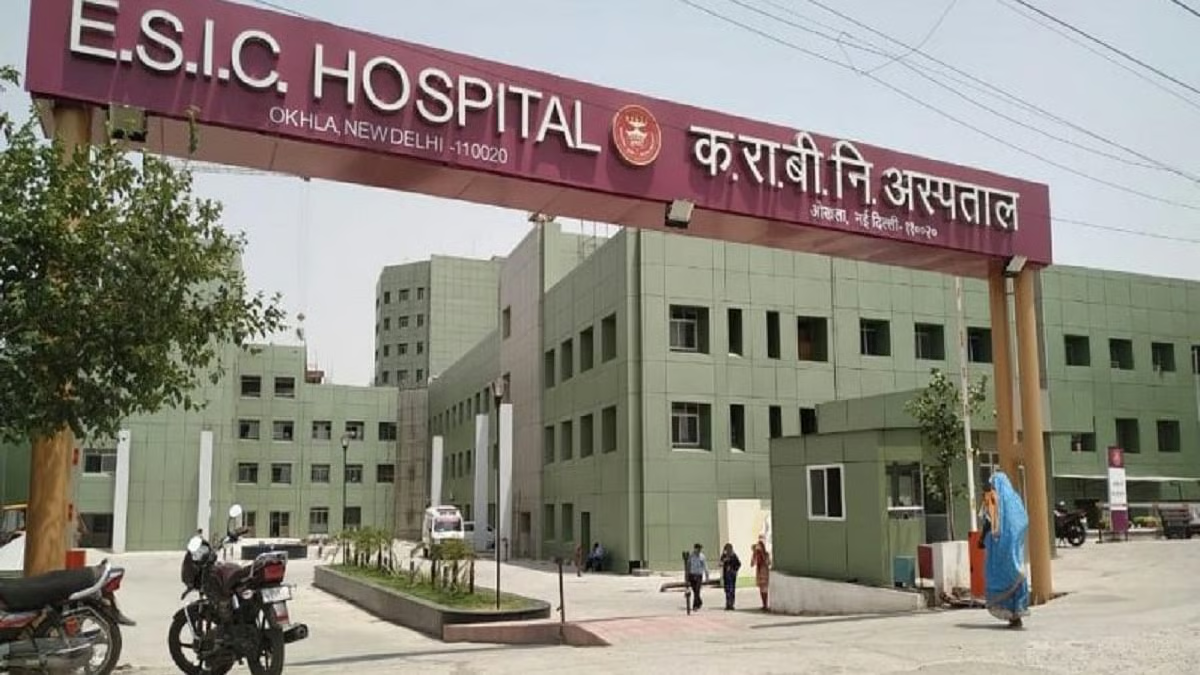

Image Source National Herald(View of ESIC Hospital)
Limit of Employees Contribution :-
Reports state that the cap on employees’ EPF contributions would be removed. Currently, employees contribute 12% of their base pay each month to the EPF account. However, the government is considering allowing employees to contribute based on their actual pay rather than the Rs 15,000 imposed by the EPFO.
Equity Limit may be Increase :-
According to some sources, EPFO is considering reinvesting a portion of the ETF redemption proceeds back into equities and other assets in order to increase returns.
Pension Scheme from any Bank :-
Mansukh Mandaviya, India’s Minister of Labour and Employment, approved the centralised pension payment system (CPPS) in September 2024. As of January 1, 2025, 7.8 million Employee Pension Scheme members would be able to collect their pensions from any bank branch in India.
Pension Dead Line :-
Employers have until January 31, 2025, to upload employee wage details, according to a news release issued by the Employees Provident Fund Organization (EPFO) on December 18, 2024. In order to finalize the increased pension application, companies must also give the clarification that EPFO requests by January 15, 2025.
Important Notes for EPF Limit :-
If Rs. 15,000 is the maximum wage, contributions are needed. The employer is not obligated to pay a higher rate even if they pay more. Both the employer and the employee must jointly request a larger contribution.
According to the provident fund legislation, an employee cannot join EPS even if they are enrolled in the EPF plan if their base pay exceeds Rs 15,000 per month. Employees who join the EPF program with a base salary of more than Rs 15,000 would now be eligible to join EPS if the wage ceiling limit is raised to Rs 21,000.
For FAQ please visit official epfo website :- https://www.epfindia.gov.in/site_en/FAQ.php
Easy Step to Withdraw money from EPFO account :-
*The EPFO Member Portal requires a captcha, password, and UAN to log in.
*Click on ‘Online Services’ and then select ‘Claim (Form-31, 19, 10C & 10D)
*Check the bank information associated with your UAN.
*Click ‘Proceed for Online Claim’ after checking the declaration.
ESIC & Mediclaim :-
The following six social security benefits are anticipated under section 46 of the Act: (a) Medical Benefit: An insured individual and his family members receive complete medical treatment as soon as they start working in an insurable capacity. The amount spent on treating an insured person or a member of his family is unlimited. Insured individuals who are retired or permanently incapacitated, as well as their spouses, are also eligible for medical care upon payment of a nominal yearly premium of Rs. 120.


Sickness Benefit (SB): For a maximum of 91 days per year, insured workers are entitled to Sickness Benefit, which is paid out as cash compensation at a rate of 70% of salaries during certified sick days. The insured person must contribute for 78 days within a 6-month contribution period in order to be eligible for sickness benefits.
1. Extended Sickness Benefit (ESB): SB is payable at an enhanced rate of 80% of salaries for up to two years in cases of 34 chronic and malignant conditions.
2. Enhanced Sickness Benefit: Insured individuals having family planning sterilization up to seven days or fourteen days for a vasectomy or tubectomy, respectively, are eligible for Enhanced Sickness Benefit equal to full wage.
(c) Maternity Benefit (MB): This benefit is paid for twenty-six (26) weeks during confinement or pregnancy and can be extended by an additional month upon medical advise at full wage, provided that contributions are made for seventy days during the two previous Contribution Periods.
In matter of Disability :-
Temporary disablement benefit (TDB): In the event of an employment injury, starting on the day of beginning an insurable job and regardless of whether any contributions have been made. As long as the disability persists, 90% of wages will be paid in Temporary Disablement Benefits.
Permanent Disability Benefit (PDB): Depending on the degree of earning capacity loss as determined by a Medical Board, the benefit is paid out monthly at a rate of 90% of wages (e). Dependents Benefit (DB): In situations when death results from an occupational hazard or work-related accident, DB is given to the dependents of a deceased insured individual on a monthly basis at a rate of 90% of wages.
Mediclaim:-
What is the employee Mediclaim policy?
Group Mediclaim Policy: Essential Coverage for Employees
A group Mediclaim policy is a type of health insurance plan that covers a number of individuals, typically workers at a company, as well as their dependents. Medical costs incurred by the insured individuals in the event of hospitalization due to illness or accident are covered by the policy.
Anyone between the ages of 18 and 65 is eligible for the New India Mediclaim program. As long as they are financially dependent, children from the ages of three months to twenty-five are also covered by the policy. If the policy is renewed on time, it can be renewed for life.
All Round coverage for Employee :-
People from a variety of social and economic backgrounds work in a corporation. Because of their upcoming obligations, some people find it nearly impossible to afford individual health insurance.
These workers will be eligible for all employee medical insurance benefits under an employee medical health plan.
Easy Claim Process :-
Having a variety of technology solutions at our disposal has made it easy to manage claims, procedures, policy dates, etc. These tools streamline, expedite, and ease the claim settlement process.
Employers can also benefit from this, which is one of the greatest medical insurance benefits for workers. The reason is because the technical tool handles the renewal or settlement of the claim, saving the employer from having to review each employee’s policy.
Less Waiting Period :-
Most health insurance policies, whether family or standalone, have a waiting period before the insured can file a claim. We refer to this as a waiting time. Since it can be an unrealistic and self-sacrificing contract for the insurance company without a waiting period, this serves as a buffer against financial loss.
However, if necessary, the concerned employee does not have to wait to file a claim thanks to employee health insurance.